
Samuel Tanner writes, teaches, improvises, and now he leads.
Tanner, professor of English Education, has been named Departmental Executive Officer (DEO) of the Department of Teaching and Learning at the University of Iowa College of Education. His appointment takes effect July 1, 2026.
Tanner succeeds Lia Plakans, professor of Multilingual Education, who has served as the DEO of Teaching and Learning since July 2018.
“Lia has elected to return to the faculty, and I am deeply grateful for her exceptional leadership as DEO,” says College of Education Dean Dan Clay. “At the same time, I am delighted to welcome Samuel Tanner into this role. He brings a combination of deep scholarly expertise, extensive K–12 and higher education experience, and a creative, collaborative spirit that will serve the Department of Teaching and Learning — and the college — very well in this new role.”
Tanner brings more than two decades of experience in education to the role. He spent nearly 15 years teaching high school English and drama in the Twin Cities before earning his doctorate from the University of Minnesota.
Before joining the College of Education in 2022, Tanner served for seven years as a professor of literacy education within the Penn State University system. A curriculum theorist, his scholarship explores critical whiteness studies, improvisation, and anti-racism, with a focus on how educators can create more equitable and responsive learning environments.
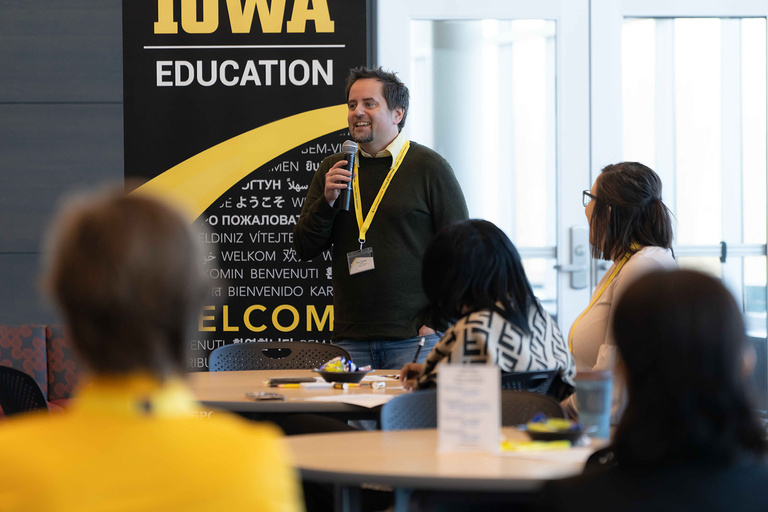
Tanner’s academic expertise is complemented by a longstanding passion for improvisational theater. Equally at home in front of a classroom or on a local stage, he combines the creativity, adaptability, and collaboration of improv with his work as a teacher, researcher, and leader. He is also a prolific and creative writer, the author of eight books, and numerous scholarly articles and essays.
As DEO of Teaching and Learning, Tanner will oversee 41 faculty members, five staff members, 148 graduate students, and 789 undergraduate students in the college’s largest academic department.
As higher education continues to evolve, Tanner sees opportunities to strengthen the department’s commitment to preparing educators, advancing impactful research, and fostering innovative teaching practices.
“I’m honored to serve the department in this role,” Tanner says. “I care about what we do in the College of Education and am ready to continue my work advocating for teachers, students, schools, and vital, transformational teaching and learning.”
Learn more about Tanner’s expertise and experience, what sparked his interest in improv, and his vision for leading the college’s largest academic department during a dynamic time in higher education.
What attracted you to the DEO position, and what excites you most about this opportunity?
I have been mentored by great leaders during my four years at the University of Iowa. Dr. Lia Plakans provided a model for leadership in higher education that emphasizes collaboration and care. I never planned to put my name forward for leadership positions but remain deeply invested in the work of teaching and learning.
How has your experience as a high school teacher shaped your approach to leadership in higher education?
K-12 teachers have tremendously difficult jobs. The work of teachers and learners matters tremendously. Nobody should use the same adjective two sentences in a row, but here we are. An educational leader’s role is to empower educators, researchers, staff, and students to create and participate in transformative experiences. In that sense, leadership isn’t so different from teaching.
My cooperating teacher once reminded me that teaching wasn’t about me. I’ve never forgotten that lesson. Leading isn’t about me, either.
How does your research expertise inform your work as an educator and administrator?
Much of my research focuses on creating more racially just schools and society. Improvisation has become central to my work as a teacher, researcher, professor, and leader. It’s often misunderstood as being comedic or unstructured, but it is neither.
When I co-founded Happy Valley Improv in Pennsylvania, we built our work around a commitment to affirming difference. As a teacher and leader, I’ve encountered difference in countless ways during my time as a teacher and a leader. As an improvisational leader, I challenge myself to welcome, honor, and build with difference in all its many forms.
How did you first become interested in improvisational theater?
During my first year as a high school teacher, students asked me to coach the school’s improv troupe. This led me to Brave New Workshop in Minnesota where I became a student of long-form improv theatre. I enjoy making people laugh, and performing for audiences has always brought my joy. Still, it is the endlessly disciplined, creative, and collaborative process that goes into cultivating the capacity for people to improvise that has captivated me. There is so much to learn from creating and sustaining transformational moments.
What lessons from improv translate most directly to leadership and teaching?
One of my mentors, Dr. Gail Boldt, argued that encountering difference is learning. Improv challenges us to learn to welcome and build off difference. This has been a part of who I am as a teacher and learner for a long time. Everything is always changing, and it is healthy to learn to riff with the difference produced by that endless change. Pretty deep, eh?
What strengths make the Department of Teaching and Learning unique?
I keep writing about difference, so I’ll stick with that. Our department brings together diverse—and sometimes competing—pedagogical, epistemological, curricular, and research traditions. I see that as a strength. Where else can you find scientists working closely with English majors or, God forbid, improvisers?
We have outstanding faculty, dedicated staff, strong researchers, and a culture that genuinely cares about improving schools and society. Honestly, this is my favorite department I’ve ever worked in, and I’ve come to care deeply about it. I’ll do my best to serve it this coming year.
What are your priorities for the department over the next several years?
I want to continue making visible the labor and contributions of our faculty across many programs and contexts. I want our faculty and students to be well, especially in challenging times, and I want to build infrastructure that supports transparency and trust. I’m committed to working with stakeholders to navigate the complexities of teaching and learning in this moment while building meaningful, lasting partnerships within our department, across the university, and with our community partners. I also want to continue creating pathways between K–12 schools and the University of Iowa that support healthy, sustainable, and transformational visions of teaching and learning for educators and students alike.
How can the department continue to support students and faculty during a period of change in higher education?
I think small moves matter. Being in meaningful relationship with each other matters. I certainly can’t solve all the challenges that are arising in higher education (or the world) right now. Still, I can show up each day, come into caring relationship with others, and make moves that serve to empower students and faculty in transformational ways. I can step forward with love regardless of what is happening around me, and that is what I plan to do, regardless of my job title.
What do you hope students and colleagues will say about your leadership style?
I hope students and colleagues will notice that I care about them and the work that they are doing. I do. I hope they will see that I am trying my best to be collaborative, transparent, thoughtful, and caring in the decisions this role will ask me to make. I hope they see that I really want them to be empowered as they move forward into their many worlds.
What inspires you most about the future of education?
Classrooms are one of the few places I’ve found where we come together with the only intention of making those around us better, generating new knowledge, and transforming reality. It can happen in improv rehearsals and on basketball courts too, I suppose, but what we are doing in colleges of education and teacher education programs matters deeply to me. I’ve made a career out of learning how to empower the transformation of those around me. I remain inspired to empower others as I step into this role. Teaching and learning matter to me.
What do you enjoy doing outside of work?
Doing improv is a lot of fun, though I don’t have as much time for it these days. I also write books. You can find my memoirs and science fiction novels on Amazon and sometimes at Prairie Lights. And by “best-selling,” I mean “worst-selling.”
I enjoy making easy layups twice a week at noon ball. And by making, I mean missing.
Mostly, I’ve come to love being in Iowa City in this moment — watching my two sons make their way through Southeast Middle School, spending time with my wife, and drinking a large vanilla cappuccino with skim milk. (Skim milk makes better foam. I learned this important fact as a barista at the original Dunn Brothers in St. Paul.)
More than anything, I enjoy learning to step into each day with love. Thankfully, the work I do is closely aligned with what I enjoy doing.
Read more from the 2025-26 Iowa Education Annual Report Magazine.