Spotlight is published periodically by the Office of Assessment and Continuous Improvement in the College of Education to highlight promising practices in assessment and continuous improvement.
This edition of the Spotlight examines Students’ Perceptions on AI and the College of Education and What Results Matter to the CoEd Most. Past editions of the Spotlight can be found on the College’s Intranet site. To be included in a future edition of the Spotlight, please contact [email protected].
College of Education Mission, Vision & Values
Mission Statement
The College of Education advances education and mental health in Iowa and beyond.
Vision Statement
The best educational and mental health outcomes for all.
Values
Practice integrity. We hold ourselves to the highest standards of honesty, transparency, and ethics. We use our resources efficiently and effectively.
Affirm academic freedom. We freely seek and share knowledge. We are responsible to our disciplines, students, profession, and institution.
Foster belonging. We welcome everyone with respect, care, and dignity. We value access and opportunity for all. We encourage rigorous and respectful dialogue.
Unlock the boundless potential in each person. We build collaborative relationships, meeting people where they are. We challenge and improve systems to empower people to become their best.
Improve continuously. We pursue excellence by learning and improving everything we do.
Contributors: Prepared by Jeremy Penn.
To share a promising practice in a future edition of the Spotlight you are using in your classroom, in your program, or in your department, please contact [email protected].
Students’ Perceptions on AI and the College of Education
In late September I was brainstorming ideas that would be good candidates for the student technology fund. I came up with several potential ideas, but after reviewing the technology fund application it was obvious I needed more justification for these ideas than simply, “Jeremy thinks this is a good idea.” Since it is the student technology fund, I thought it best to ask students about what was most important to them.
The College of Education Students’ Perceptions of AI (artificial intelligence) survey was created with three sets of questions. The first set of questions asked students about their perceptions about AI and its use in the College of Education. The second set of questions asked students for their opinions on which activities, if any, students would like to see the College of Education engage in related to AI. The final question was an open-ended question where students had the opportunity to share any additional thoughts they had about AI. I developed the questions myself (I thought it in bad taste to ask AI to develop survey questions about AI). The survey was sent to a random selection of 500 College of Education students and 77 answered one or more questions to the survey (15% response rate). The full survey results are available through the College of Education’s data portal.
Perceptions of AI and its use in the College of Education
The response choices for these five questions were: 1 = Strongly Disagree, 2 = Disagree, 3 = neither agree nor disagree, 4 = Agree, 5 = Strongly Agree.
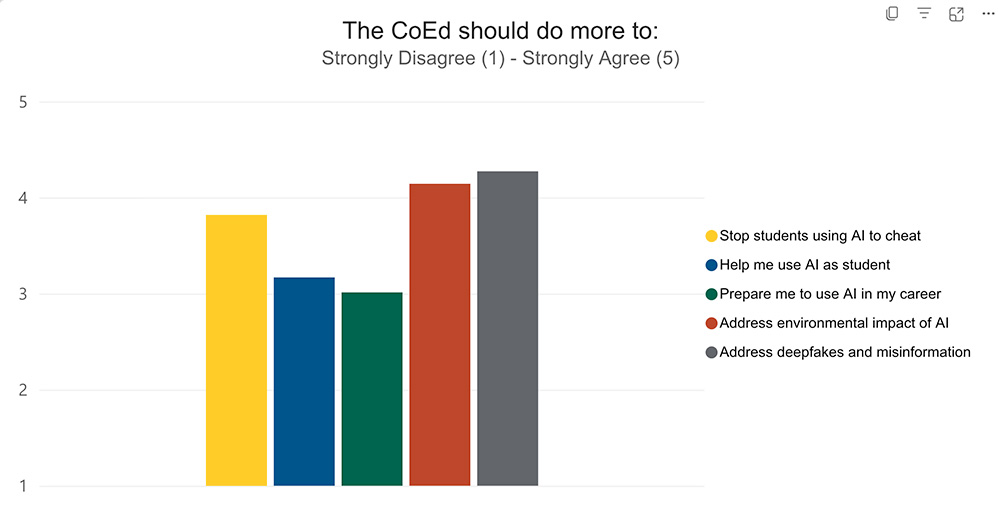
The College of Education should do more to:
- Address deepfakes and misinformation from AI (M = 4.27, 79% agree).
- Address the environmental impact and sustainability of AI (M = 4.14, 81% agree).
- Stop students from using AI to cheat in classes (M = 3.82, 65% agree).
- Help me use AI effectively and appropriately as a student (M = 3.17, 48% agree).
- Prepare me to use AI in my future career (M = 3.01, 44% agree).
Activities Associated with AI the College of Education Should Consider
The response choices for these eight questions were: 1 = Definitely should NOT do this, 2 = Probably should not do this, 3 = Neutral (no opinion), 4 = Probably should do this, 5 = Definitely should do this.
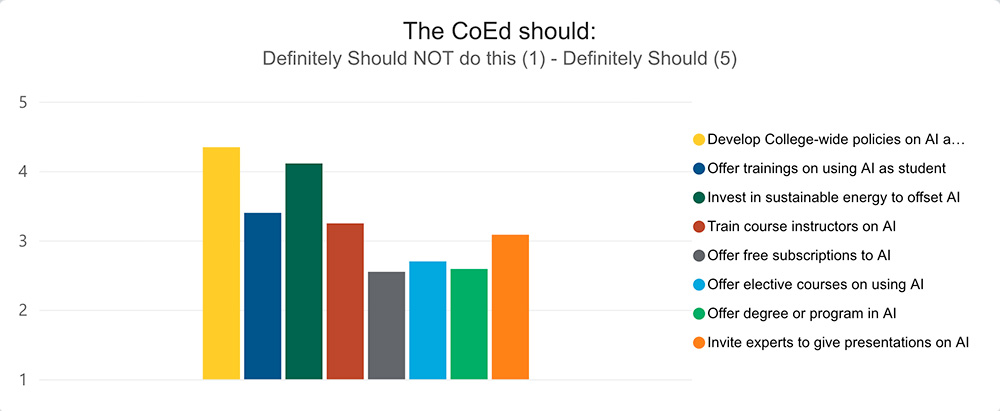
Please indicate if you would like to see the College of Education engage in each of the following activities associated with AI. The College of Education [response]:
- Develop College-wide policies on AI and academic misconduct (M = 4.34, 85% should do).
- Invest in sustainable energy sources (e.g., solar panels) to offset energy used by AI (M = 4.11, 74% should do).
- Offer stand-alone trainings and workshops for students on how to use AI effectively as a student (M = 3.40, 51% should do).
- Train course instructors to use AI effectively in their teaching (M = 3.25, 53% should do).
- Invite external experts in AI to give presentations to students and instructors (M = 3.08, 42% should do).
- Offer elective courses that focus on using AI (M = 2.70, 30% should do).
- Offer a degree program or certificate that develops skills for using AI (M = 2.59, 23% should do).
- Offer free student subscriptions to a variety of AI agents, chatbots, and tools (M = 2.55, 30% should do).
Open-ended Responses
Many respondents offered strong opinions on AI, with most of the comments suggesting caution for use of AI, opposition to AI, and general concerns about AI. A few samples of cautious or critical comments include (full comments available at https://data.uiowa.edu/item/1618656103/data):
- “It’s so bad for the environment and for our brains as creative and smart human beings.”
- “I think the amount of AI used in the College of Education currently is concerning…Teaching is a human endeavor, and it is meant to be done by humans with their own brains…The future students [of the CoEd] deserve better.”
- “AI is very dangerous for a host of reasons. It should only be used in limited ways and very carefully.”
A few comments pointed toward benefits or positive outcomes from engaging more closely with AI:
- “AI is going to become something that students need to be comfortable with and know how to use smartly to go far in business…If the school can help students use it smartly and correctly, it will only be for the better.”
- “I think an ethics course on the use of AI in the development of classroom materials or its use in administrative functions would be useful as AI integration becomes more prevalent in the classroom.”
Conclusion
I am glad I asked students before submitting an, shall we say, uninformed student technology fund proposal. My initial ideas were either impractical (e.g., putting solar panels on the roof of the Lindquist Center) or were not strongly supported by students (e.g., providing free licenses to popular AI tools, developing an AI course, or bringing in an external speaker to present on using AI). Although this project did not turn into a student technology fee proposal, it did provide students an opportunity to share their perspectives on AI and continue the conversation about the intersection of teaching and learning with technology.
What Results Matter MOST for the College of Education’s Success?
As shared at the fall townhall, the College of Education is participating in the 2026-2027 Baldrige Performance Excellence Program. The College, which last participated in a full Baldrige Examination in fall 2023, participates in the Baldrige Performance Excellence program for three reasons. First, it is an opportunity to thoughtfully and carefully review the College’s processes and performance in a low-stakes setting. Second, it provides the College with feedback from a group of external organizational effectiveness experts who help the College identify strengths, opportunities for improvement, and blind spots. Third, it offers the College the opportunity to have its efforts to advance education and mental health in Iowa and beyond recognized through an awards process.
The first task as part of the Baldrige Performance Excellence Program is to write the College’s Baldrige application. The Baldrige application asks the College to explain its processes in six areas: leadership; strategy; students and other customers; measurement, analysis, and knowledge management; workforce; and operations. Each of these six areas has an associated results section where the College provides data to show how well it is performing in each of these areas.
As you might imagine, given the breadth and scale of the College of Education’s programs, services, and research activities, the Baldrige application can quickly become rambling and lengthy to the point where it becomes nearly incomprehensible. To address this issue, the Baldrige application asks organizations to identify a small number of key results that are most important to the College’s success. For the 2026 Baldrige application, the College has identified its key results as those that directly align with the College’s strategic priorities: student enrollment (strategically grow enrollment), timely degree completion (student success, satisfaction, and belonging), research performance (grow impact of research on education and mental health), and employee engagement and belonging (strengthen employee engagement and belonging). A summary of the College’s performance in these areas is provided below. Interactive data charts are available to the College of Education’s staff and faculty members on the College’s Strategic Plan data portal: https://data.uiowa.edu/item/473676207/data.
Enrollment
The College has had tremendous success in growing its enrollment over the last 11 years. Total enrollment in the College of Education is up 53% from 2016 to 2026. While much of this enrollment growth has been driven by the College’s new and innovative undergraduate programs, updates and enhancements to the College’s graduate programs have also contributed to enrollment success despite an increasingly challenging enrollment landscape.
Timely Degree Completion
Timely degree completion is a priority for students and represents effectiveness in the College’s ability to offer courses and the school or clinical placements needed for students to graduate on time. The College has achieved good results in graduating students on time, particularly in its master’s degree programs where more than 80% of students completed their degrees within 3 years (150% of program length) across the last five years. This is a particularly noteworthy achievement since many students in the College’s master’s degree programs have full-time jobs or other commitments outside of attending class.
For PhD students the College has achieved good success in 6-year completion, meeting the 60% completion benchmark in 3 out of the last 5 years. As with master’s degree students, this is an impressive achievement since many PhD students in the college work full time and have other responsibilities outside their degree programs.
For its undergraduate programs, the College will have four-year and six-year graduation rates available in the next few years, as the College only began enrolling students as freshmen a few years ago. In the meantime, the College works hard to achieve high retention of students in its undergraduate programs and tracks 3-year completion of students who enter the teacher education program as juniors, with nearly 75% completing their program within 3-years of admission to the upper-division Teacher Education Program.
Research Performance
Measuring research performance is challenging because there is no single definition of a “scholarly work” (such as what counts as a scholarly work and whether certain works count more or less than others) and because there is no universal database of research activities for faculty in the College of Education or faculty at other comparable institutions. Researchers have proposed a variety of indices and scales, such as the h-index, but these can distort scholarly work and can be difficult to interpret.
Given these issues, the College uses publications per faculty member as calculated by taking the number of journal article publications (as reported by SciVal for publications by institution in the areas of education, applied psychology, clinical psychology, and developmental and educational psychology) divided by the number of tenured or tenure-track faculty members (as reported by institutions to US News). While this measure excludes many important scholarly works, such as books and book chapters, it is one way to measure research productivity that can provide comparative information across institutions and accounts for the varying sizes of the education faculty. The comparison institutions, selected by the College of Education to provide a challenging but meaningful set of comparison institutions, include 17 of the top public colleges of education, such as University of Washington, Indiana University-Bloomington, and University of Michigan-Ann Arbor. In 2025, while the number of publications per faculty member for the College of Education was lower than the median of the selected peers, it was at its highest level in at least the last 11 years, showing strong growth from 2022 to 2025.
The other key measure of research performance is the research funding expenditure per faculty member. This is calculated using the data submitted by institutions to U.S. News and World Report as part of its annual rankings of graduate colleges of education. Since 2019, the College of Education has produced significantly more research funding per faculty member than the median of its peers, with results in 2024 and 2025 that were the highest ever for the College.
Employee Belonging and Engagement
None of these achievements would be possible without a talented, committed, and engaged workforce. The College has sustained a highly engaged workforce in each administration of the Working at Iowa survey, at or near the engagement for staff and faculty across the University of Iowa.
In the 2024 Working at Iowa survey, the College’s results in 2024 improved in 10 out of 19 items repeated from the 2022 survey, with no items showing significant declines from 2022 to 2024. Areas where the College made large gains in employee engagement from 2022 to 2024 included: “management of work-related conflicts” (84% in 2024 vs. 73% in 2022, UI average of 80%), “I can speak about work-related concerns with my supervisor” (91% in 2024 vs. 80% in 2022, UI average of 90%), and “given the opportunity, I tell people great things about working in my unit” (88% in 2024 vs. 83% in 2022, UI average of 88%).
What’s next?
Faculty and staff members in the College of Education are invited to explore these results and other top measures of success on the data portal for the College of Education. The Baldrige examiner team will visit the College during the spring semester and will be holding meetings with a broad range of representatives across the College during their visit. Feedback from the Baldrige examiner team will be available in mid-2027 with numerous opportunities to discuss and use the feedback to support the continued success of the College throughout the second half of 2027 and into 2028. Thank you for all you do to support the College of Education’s work to produce the best educational and mental health outcomes for all!
Additional Resources
- IgniteEx 2027 Performance Excellence Conference, April 8-9, 2027, Prior Lake MN
- Continuous Improvement Summit, February 23-26, 2027, Online
- Past editions of the Spotlight now on the College of Education Intranet