
Julie M. Koch knows how powerful an introductory course can be.
As a professor of counseling psychology in the University of Iowa College of Education, Koch has spent years teaching undergraduate students about a field that is complex, evolving, and full of possibility. But when she looked for a textbook for her introduction to counseling psychology course, most available texts were written for doctoral students.

So, Koch helped create the book she wished her students had.
Her new book, Foundations of Counseling Psychology: An Introduction to the Field, co-authored with Douglas Knutson, an associate professor at Oklahoma State, introduces undergraduate students and others exploring the field to the values, settings, skills, and career pathways within counseling psychology. Set to be released May 6 by Routledge Publishing, the book is designed to be accessible and engaging without losing the depth of the profession.
Koch discussed what inspired the book, how the field is changing, and what she hopes students take with them after reading it.
What inspired you to write this book?
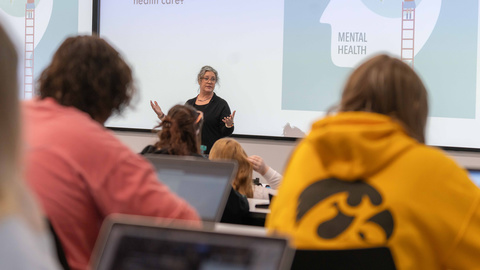
I love working with undergraduates, and I teach an introduction to counseling psychology course. Historically, counseling psychology has been taught at the doctoral level, so most of the textbooks available were written for doctoral students.
They were often inaccessible for undergraduates because the language was so academic and dense. For a while, I used articles, but I still felt like I wasn’t able to fully communicate the field through those readings.
I thought it would be useful to have a textbook written for this audience, so I wrote one with my colleague Douglas (Knutson).
What need were you hoping to meet?
Over the last 10 years, more undergraduate minors, majors, and certificates in counseling psychology and behavioral health services have emerged across the country. Iowa has one of the first majors.
My hope is that faculty in these programs will see the book as a useful resource. One of our biggest goals was to make the language digestible, friendly, and dynamic so students could get excited about counseling psychology rather than feel overwhelmed by it.
How did you decide what to include?
The first several chapters focus on the foundational values of counseling psychology and help distinguish it from school psychology, clinical psychology, and counseling.
The book also explores research, theories, skills, and the many settings where counseling psychologists work, including hospitals, tribal health, and private practice.
One of my favorite parts is the final chapter, which offers practical advice for applying to graduate programs, such as how to ask for a letter of recommendation and the difference between a resume and a CV.
How does the book show the field as it exists today?
The book includes the history of counseling psychology, but it also looks toward the future. We discuss job growth, telehealth, artificial intelligence, and newer theoretical approaches alongside traditional ones.
Every chapter also includes a spotlight on a counseling psychologist. Three University of Iowa alumni are featured: Ted Pickett, Jr., who is Associate Director of the Counseling Center at Maryland University, Yun Garrison, who teaches at a small liberal arts school, and Zeus Pichardo, who works at the Belin-Blank Center.
Those spotlights help students see what counseling psychology looks like through people actively working in the field.
What did you especially want students to understand?
I wanted students to understand the range of settings where counseling psychologists work.
Students often picture counseling psychology as private practice, with a therapist holding a clipboard while a client sits on a couch. But the field is much broader. Counseling psychologists may work with veterans in hospitals, collaborate with doctors and social workers, or practice in community-based settings.
One spotlight features a former student of mine who works with veterans in St. Louis and incorporates scuba diving as part of therapy. I wanted students to see those possibilities.
What was the most meaningful part of writing it?
The whole time I was writing, I was thinking about my undergraduate students at Iowa. They are curious and fun, and I wanted the book to serve them well.
It was also meaningful to collaborate with my co-author, who is a former student of mine and now a professor.
Another special part was having John Westerfeld, professor emeritus, write the foreword. He helped start the introductory counseling psychology class at Iowa, so having him share that history was very meaningful.
What feature of the book are you especially excited about?
Each chapter includes a “What would you do?” section that gives students a realistic dilemma to think through.
For example, one scenario asks students to imagine they are taking an introduction to counseling psychology class and, while getting their teeth cleaned, their dental hygienist begins sharing family mental health concerns and asks for advice.
Those prompts can be used for reflection, writing assignments, or class discussions. They help students apply what they are learning in a practical way.