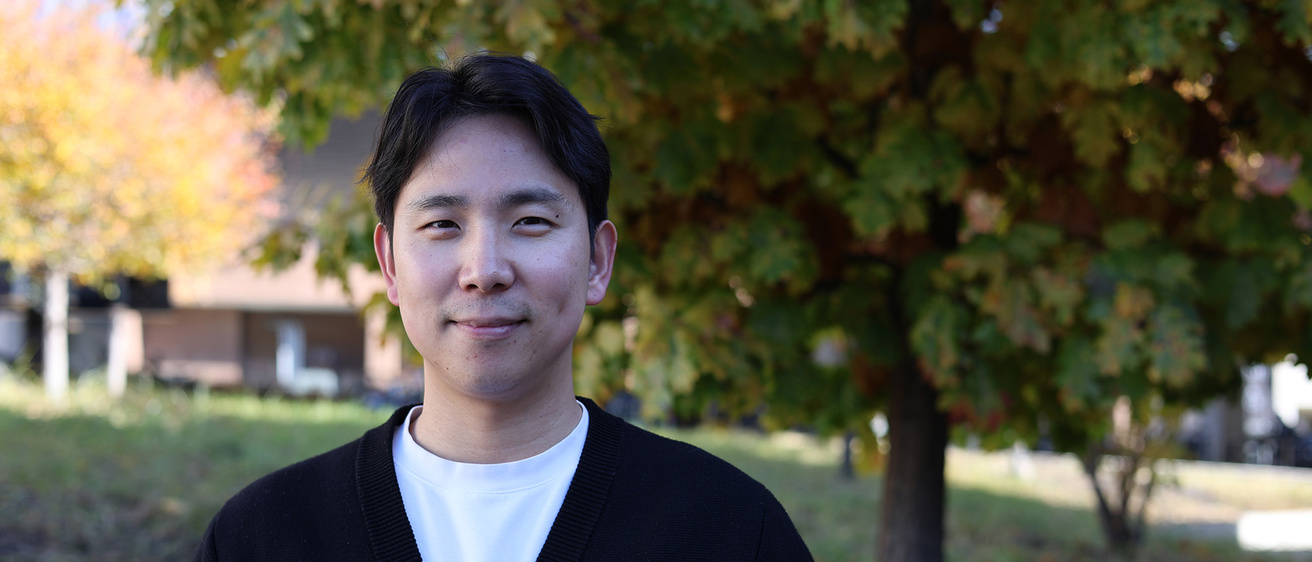
With a global vision and a deep commitment to mental health, University of Iowa assistant professor Isak Kim is developing a new app designed to support students’ well-being and prevent mental health crises. Backed by a $10,000 Global Research Partnership Award from UI International Programs, Kim’s project connects innovation, research, and cross-cultural collaboration to save lives.
Since joining the College of Education as an assistant professor in Clinical Mental Health Counseling in the Department of Counselor Education this August, Kim is exploring ways to leverage his connections with universities and medical centers in South Korea to address mental health challenges in Iowa.
Kim received his Master of Arts degree in Education Counseling from Seoul National University before moving to the U.S. to earn his doctorate in Counselor Education and Supervision from Penn State University in 2017.
After four years as an assistant professor at the University of Nebraska at Omaha, Kim joined the College of Education faculty this fall. He says he was drawn by the college’s strong emphasis on mental health and its support for related initiatives through the Scanlan Center for School Mental Health.
Mental health has always been a source of passion for Kim. His home country of South Korea faces one of the highest rates of youth suicide in the world, and he has seen its effects.
“I know how impactful it is, not only for that student's family, but for the school and whole community when those incidents happen,” he says. He adds that behind every suicide statistic is a ripple effect that touches far more lives than the data can show. “It's way more than a number.”
His passion for mental health is what’s brought him to his latest project.
In collaboration with the Ajou Medical Center in Suwon, South Korea, Kim and a multidisciplinary team of psychiatrists, software engineers, and translators are adapting a prototype mental health app developed in South Korea to test with American teenagers. The app, NAVO, connects students with school counselors through mental health screenings, chat functions, and reporting systems.
Kim recently received $10,000 in funding through the University of Iowa Global Research Partnership Award. The award supports up to $10,000 to initiate an international research collaboration between the University of Iowa and Ajou University Medical Center, with a focus on culturally adapting and testing the NAVO digital therapeutics app for U.S. adolescents.
Using artificial intelligence, the project aims to identify students at risk for mental health challenges and suicidal ideation. The app also serves as a peer support platform, allowing students to share advice, post anonymously, and report concerns to counselors—a feature Kim says is especially vital in today’s digital age.
“When a student in school settings is in crisis, such as showing signs of severe distress or suicidal thought, in many cases, the person who's noticing for the first time is a peer,” Kim says. “Reports say that in all cases of school shootings there was at least one peer who noticed the risk, but they didn’t report it.”
Although the app was originally developed in South Korea, Kim believes its implementation could help address critical mental health challenges in Iowa. With many rural communities facing shortages of counselors and mental health resources, he says this technology could extend vital support to areas that need it most.
In Iowa, the Department of Health and Human Services reports that around 500 people die by suicide each year. Those from rural communities are disproportionately impacted, due to isolation, access to guns, and a lack of mental health support. The Scanlan School for School Mental Health notes that youth suicide rises nationally every year.
Once translation and technical support is determined, Kim will connect with middle- and high-school students in the area to test and implement the app. If all goes as planned, Kim’s work could offer a new lifeline for students, providing timely mental health support where it’s needed most.
“The goal is that no adolescent is just completely isolated. There should be some spaces for them to get the help they need. I just hope this kind of new technology-based intervention efforts, combined with human connections, can be one of the platforms and outlets they feel like ‘I'm not totally isolated.’”