The first time Katy Schroeder truly understood the positive impact of connecting people with animals in therapy, she wasn’t sitting in a lab or behind a desk. She was standing beside a horse.
“I realized how passionate I was about integrating human-horse interactions into mental health treatment,” she recalls. “It was such a powerful realization.”
At the time, Schroeder was living in Bend, Oregon, and pursuing her master’s degree in clinical mental health counseling. The idea of incorporating animals into therapy wasn’t new — but it also wasn’t widely studied or regulated. Still, something about it clicked. It lit a path she hadn’t seen before.
“I caught the research bug,” she says. Encouraged by a mentor, Schroeder stayed on to earn her doctorate at Oregon State University, where she discovered her second calling: teaching. “That’s really when everything started to come together for me.”
That clarity eventually led her to the University of Iowa, where she now serves as an associate professor in the College of Education's Clinical Mental Health Counseling Program in the Department of Counselor Education. There, she’s quietly reshaping how students — and the field—understand the relationship between humans and animals in mental health care.
Though Animal-Assisted Therapy in Counseling (AATC) wasn’t part of her original job description, Schroeder brought the specialty with her. “As far as I know, I’m the first person on the faculty at Iowa with a focus on incorporating therapy animal interactions into mental health treatments,” she says.
From the beginning, her vision has been both ambitious and grounded: build opportunities for counseling students to get hands-on experience with counseling incorporating animal interactions, design a research-backed tool to measure its effectiveness, and create a supportive mentorship model to sustain it all.
“My personal goal is to add specialized coursework and eventually offer opportunities for our students to get practicum or internship hours with exposure to integrating equine or canine interactions into treatment,” she says. “Right now, that kind of experience is limited unless they pursue it on their own.”
Tyler Gray, a doctoral student in the Counselor Education and Supervision program, was one of those students. She arrived at Iowa with a deep interest in trauma work, non-traditional modalities — and a long history with animals.
“I grew up in Georgia and was heavily involved in 4-H — horses, dogs, rabbits, goats,” Gray says. “Animals were an important part of my own healing process.”
Still, it took a while for her to realize that therapy with animal interactions could be a career. “At first, I laughed it off — I didn’t think that was a real thing,” she says.
But while volunteering at an organization supporting survivors of sex trafficking, she saw therapy with the incorporation of horses in action. By the time she was applying for doctoral programs, she was looking for one that would let her explore that work more deeply.
That’s when she met Schroeder.
“She brought up horses in our conversation, and I was immediately intrigued,” Gray says. “That moment really helped solidify my decision to join the program here.”
Iowa checked all her boxes – a Big Ten Research I institution with a rigorous and well-respected academic program and a faculty expert in human-animal interactions in mental health care.
Since then, the two have formed a collaborative partnership built on shared goals, mentorship, and mutual respect.
“Tyler cares deeply about developing competencies,” Schroeder says. “She’s very patient with me — especially because I’m a stickler when it comes to things like terminology and ethical standards.”
Together, they’ve worked on two major projects. One involves a community-based partnership with Miracles in Motion, an Equine-Assisted Services Center in Eastern Iowa, to develop Veterans mental health programming. The other — a Delphi study funded by a grant from the Iowa Measurement Research Foundation at Iowa — is at the heart of Schroeder’s current research: gaining expert consensus to develop a standardized tool to measure therapeutic outcomes in AATC.
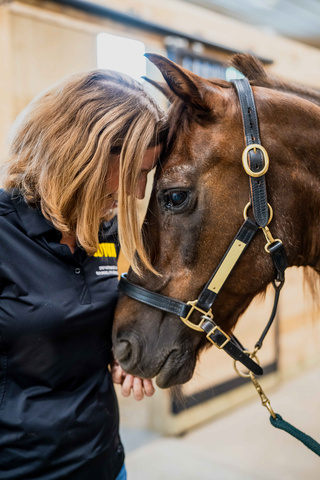
“In counseling, we often use standardized assessments like the Beck Depression Inventory,” Schroeder explains. “But when it comes to incorporating therapy animals into treatment, we don’t have any measures that assess how therapy animals are actually helping a client—or whether these interactions lead to specific improvements in client outcomes.”
The goal is to create an instrument that therapists can use across settings and species to assess specific outcomes like emotional regulation, identifying emotions, or setting boundaries.
“We’re developing an outcome-based scale,” Gray says, “one that outlines how animal-assisted therapy can support specific client outcomes, whether it’s with dogs, horses, or other animals.”
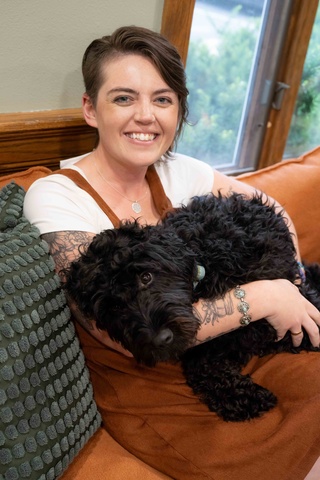
In the field, Gray is already putting the theory into practice. She works with her therapy dog, Frankie – an Australian Labradoodle – and partners with an equine-assisted services center to facilitate counseling sessions with equine interactions. Her clients range from children in play therapy to Veterans working through PTSD.
“Frankie is part of my therapeutic team,” she says. “She co-regulates during eye movement desensitization and reprocessing sessions, helps kids open up, and provides a grounding presence for clients navigating trauma.”
Her equine work is just as intentional. “In individual sessions, we might work on boundaries, sensory regulation, or grief,” Gray explains.
“The metaphors drawn from these interactions help clients apply what they learn in therapy to real-life relationships and emotional challenges.”
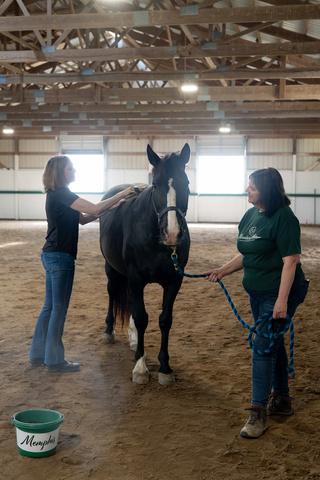
That kind of hands-on, client-centered work is exactly what Schroeder hopes to make more accessible to Iowa students in the future through new courses and partnerships.
“I really don’t want this kind of creative, outside-the-box work to stay siloed,” she says. “My hope is to help people understand just how meaningful and impactful human-animal interactions can be.”
That impact, both women agree, goes far beyond the therapy room.
“Every person has some sort of connection to animals,” Gray says. “Even if it’s not a real dog—sometimes it’s a stuffed animal in a foster child’s backpack—those relationships help people feel less alone. And that’s the heart of good therapy.”
Schroeder sees that too. Whether it’s trauma survivors grooming horses to ground themselves, or Veterans gaining confidence through connection, the healing that happens in these spaces is real. But for it to be taken seriously, the field needs standards, training – and mentorship.
“As co-director of a new Obermann Center for Advanced Studies Working Group, our goal is to bring together people across the community who work with therapy animals, service animals, and emotional support animals to help create more awareness and consistency around best practices,” Schroeder says.
“Loving animals isn’t enough,” Schroeder says. “You need specific training on how to ethically and effectively integrate animals into treatment. You also need to understand the animal’s needs and boundaries.”
That’s where mentorship plays a crucial role.
“When I arrived, I was nervous to ask Dr. Schroeder if I could work with her — I admired her so much,” Gray says. “But she was incredibly welcoming. She encouraged me to pursue certification and helped connect me with people who train therapy animals.”
Schroeder hopes to build on that model by creating what she calls “layers of mentorship,” where advanced students like Gray mentor newer ones. “That’s how we’ll train the next generation to do this ethically and effectively,” she says.
The field of animal-assisted therapy is still emerging, but with leaders like Schroeder and students like Gray, its future is being shaped with purpose, passion, and a clear vision. And for those witnessing — or participating in — the quiet power of a horse’s steady breath or a dog’s calming presence, the impact is already undeniable.
Thanks to Rural Health Care Partnership funds from the state of Iowa, the Clinical Mental Health Counseling MA program has increased enrollment from 33 students last fall to more than 50 this fall.