
The University of Iowa College of Education has recognized Megan Foley Nicpon and Seth King as recipients of the 2025–26 Collegiate Teaching Award, the college’s highest honor for exemplary teaching and mentorship.
The award recognizes faculty who demonstrate excellence in instruction, innovation in curriculum, and a deep commitment to student success. Awardees are nominated by faculty and students, and each recipient receives $2,000 and a commemorative gift.
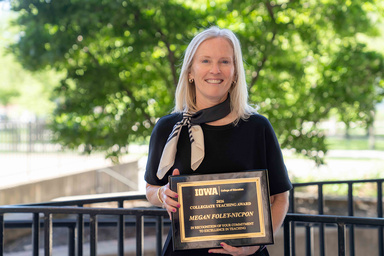
Foley Nicpon, the Myron and Jacqueline Blank Endowed Chair, director of the Belin-Blank Center, and professor of counseling psychology, was honored for her commitment to teaching, supervision, clinical training, and student mentorship across counseling and school psychology programs.
Her teaching emphasizes the scientist-practitioner model and helps students think critically about the personal, cultural, and professional assumptions that shape their work as future psychologists. Colleagues and students praised Foley Nicpon for creating learning environments that are both rigorous and supportive.
“Megan creates learning environments where students feel both challenged and supported as they develop their professional identities,” writes Saba Rasheed Ali, associate provost for graduate and professional education and dean of the Graduate College, in her nomination letter.
Foley-Nicpon has also helped strengthen the college’s child psychology curriculum, creating an undergraduate applied child and adolescent psychology course and later developing an advanced applied child psychology course for graduate students. Her teaching extends beyond the classroom through applied learning opportunities connected to the Belin-Blank Center, where students gain experience working with children, adolescents, and families.
“Dr. Foley Nicpon is the epitome of an exceptional teacher,” writes Monee’ Turner, a doctoral candidate in counseling psychology. “She consistently comes to class prepared, listens carefully to students, provides meaningful feedback, and allows us to influence the direction of class content.”
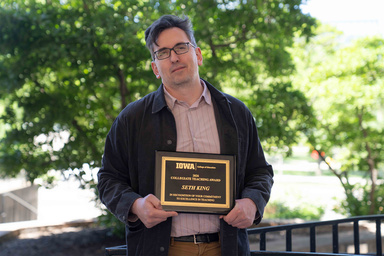
King, associate professor of special education in the Department of Teaching and Learning, was recognized for his outstanding teaching, mentorship, and leadership in special education and applied behavior analysis.
His teaching is grounded in the principles of effective instruction: modeling, active responding, and systematic feedback. His courses incorporate applied projects, formative assessments, emerging technologies, and real-world practice to help students connect complex concepts to the work they will do in schools, clinics, and communities.
Colleagues praised King’s commitment to inclusive and equitable teaching practices, clear course organization, timely feedback, and accessibility to students across online, hybrid, and in-person formats.
“Dr. King develops creative coursework that inspires students and makes learning both engaging and effective,” writes Lia Plakans, professor of multilingual education and departmental executive officer of teaching and learning, in her support letter.
King’s mentorship also extends beyond coursework. He advises students across multiple programs, supports graduate students in research and professional development, and helps students gain experience through presentations, publications, and applied projects.
“Dr. King embodies the highest ideals of a scholar-teacher,” writes Naicong Xie, a doctoral student in special education and applied behavior analysis. “He combines expertise with humility, rigor with compassion, and high expectations with unwavering support.”
Foley Nicpon and King were nominated by students and colleagues who praised their teaching excellence, mentorship, innovation, and lasting impact on students. Their work reflects the spirit of the Collegiate Teaching Award and the college’s commitment to preparing future educators, psychologists, researchers, and practitioners.