
For well over a century, schoolteachers in the United States have commonly worked on nine-month contracts. For the remaining three months in the calendar year, administrators encouraged them to rest, study, and travel to improve their teaching skills and knowledge—even though they were not paid for the summer months. History shows that for some teachers there was sometimes more at stake.
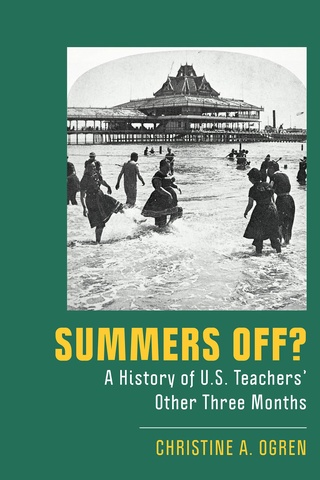
Summers Off? A History of U.S. Teachers’ Other Three Months, a new book by University of Iowa College of Education Professor of Higher Education and Student Affairs Christine A. Ogren, published by Rutgers University Press, describes how teachers would often use the summer months to pursue their version of professional development as well as to ensure their financial well-being.
Rutgers University Press explains, “Summers Off explores teachers’ summer experiences between the 1880s and 1930s in institutes and association meetings; sessions at teachers colleges, Black colleges, and prestigious universities; work for wages or their family; tourism in the U.S. and Europe; and activities intended to be restful. This heretofore untold history reveals how teachers utilized the geographical and psychological distance from the classroom that summer provided.”
Ogren believes it was important to provide an accurate historical depiction of what a calendar year for schoolteachers truly looked like during this time period.
“Since the nine-month school year became common in the U.S. in the 1880s, teachers have hardly taken the summer ‘off.’ They have enriched their knowledge at summer schools, worked in a variety of jobs which sometimes took them to exciting new places, and toured the U.S. and Europe,” says Ogren. “Although school administrators attempted to control how teachers spent their summers, teachers used their summer experiences to enhance their professional and intellectual independence, their membership in the middle class, and, in the cases of women and Black teachers, their defiance of gender and race hierarchies.”
Summers Off is the second book authored by Ogren, who is a professor in the college’s Higher Education and Student Affairs (HESA) program in the Department of Educational Policy and Leadership Studies (EPLS).
“Early in my time on the faculty at UI, I began teaching a graduate seminar titled ‘History of the Teaching Profession.’ As my students and I read about teacher education and the many restrictions on teachers’ lives through history, I wondered what the teachers did in the face of the restrictions,” explains Ogren.
“In Ken Burns’s documentary on the history of national parks, I saw that some teachers explored and worked in the parks during the summertime. I realized that other historians hadn’t paid much attention to teachers’ summer months, and I wondered what I could learn about teachers by examining the time when they were away from the classroom.”
With grant support that spanned several years, Ogren was able to conduct research in more than a dozen states at archives ranging from Harvard University to Yellowstone National Park to the Iowa Women’s Archives.