
University of Iowa College of Education doctoral candidate in Language, Literacy, and Social Studies Education Colleen Kollasch has received the College and University Faculty Assembly (CUFA) National Technology Leadership Initiative (NTLI) Fellowship Award at the National Council of the Social Studies College and Faculty Assembly annual conference for her paper, “Evaluating LGBTQ+ History Curriculum: Inquiry, Criticality, Teacher Agency, and Digital Affordances.” The award recognizes exemplary scholarship related to technology in social studies education.
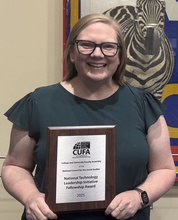
Kollasch led the research with co-authors Eric B. Freedman, an assistant professor of social studies education at Iowa, and Tina Y. Gourd (University of Washington). The study examines what’s available to teachers searching online for LGBTQ+ history lesson plans — and evaluates whether those resources support strong inquiry-based instruction, critical analysis, and meaningful use of digital tools.
“The Internet is the ‘Wild West’ of curriculum materials, with little vetting or oversight,” Freedman says. “We systemically reviewed what’s available for teaching LGBTQ+ history against established criteria. The study is really the first of its kind.”
“Representation in what students learn matters,” Kollasch says. “It’s important for LGBTQ+ students to see themselves reflected, and it’s also important for every student to understand the rich complexity of people’s lives and histories.”
Kollasch reviewed LGBTQ+ history lesson plans from multiple websites and evaluated them using the Curriculum Materials Evaluation Tool (CMET), a framework designed to assess the quality and usability of curriculum materials and developed by Freedman and Gourd. Her analysis found that LGBTQ+ history resources can be difficult to locate, limited in number, and often uneven in quality — with many lessons relying on surface-level narratives rather than encouraging deeper inquiry and criticality.
Teachers face real barriers finding materials, according to the research. Search features on some sites can be inconsistent, making it harder to locate relevant LGBTQ+ history content. Many lessons rely on familiar, “hero story” approaches and don’t consistently elevate everyday voices, counter-narratives, or intersectional perspectives. “Digital” resources aren’t always digitally taught. Some lesson plans are delivered as printable PDFs and don’t require students to use technology, limiting the digital learning opportunities those materials claim to offer, according to Kollasch’s research findings.
Kollasch says the goal is practical: help educators identify what exists, understand quality, and support stronger classroom implementation. “Teachers want to do this work,” she says. “They know it’s necessary — not just for LGBTQ+ students, but for all students to understand the world and the people in it.”
The NTLI Fellowship was established in 2000 through a collaboration led by the Society for Information Technology and Teacher Education (SITE) and partner teacher-education associations. Each year, fellows are invited to present their work at a dedicated symposium at the SITE conference and receive an award plaque and complimentary conference registration.
Kollasch says she hopes the research helps educators feel less isolated as they navigate how to teach LGBTQ+ history amid shifting local and state contexts. “You’re not alone,” she says. “Lean on other teachers who want to do this work — and keep building your own content knowledge so you can teach more confidently.”
Kollasch is also awaiting a journal decision on the manuscript and plans to extend the work through classroom-based research with teachers and, ultimately, student feedback on LGBTQ+ history learning experiences.