
When senior Lucy Blissenbach first heard about the University of Iowa College of Education Honors Opportunity Program (HOP) in the Belin-Blank Center, she was equal parts intrigued and intimidated. The idea of joining an honors program was unfamiliar, and she was worried she wouldn’t fit in.
“I had such bad imposter syndrome,” she recalls.
Less than a year later, in April of this year, Blissenbach proudly presented her research to staff and faculty at the College of Education, earning her honors from HOP for her study.
This Thursday, she’ll walk across the stage and officially graduate with her honors and Bachelor of Arts in Education Studies and Human Relations (ESHR), along with a certificate in resilience and trauma-informed perspectives.
Four years ago, Blissenbach chose the University of Iowa College of Education for its ESHR program. She credits the program’s flexibility with allowing her to find her own path in education.
“I’ve always known that I wanted to work with children in some way. My mom is a teacher, and my grandma was also a teacher,” she says. “The ESHR program was a huge draw for me [to Iowa] because I didn’t know yet if I wanted to be a traditional classroom teacher.”
“With the ESHR program, I’m able to learn about teaching skills and child development while also having a broad path of jobs that I could look at after college as well,” she says.
The program’s freedom led her to several extracurriculars, including the student-run Women in Business campus organization and the College of Education’s Hawkeye Student Ambassador program.
It also led her to the college’s Honors Opportunity Program that currently hosts ten students from the ESHR program, the Counseling and Behavioral Health Services program, and the Teacher Education Program.
While in HOP, Blissenbach worked closely with mentor Duhita Mahatmya, assistant professor of learning sciences and educational psychology, to conduct research on a meaningful topic for Blissenbach – the association between children’s academic outcomes and their parents’ work stress.
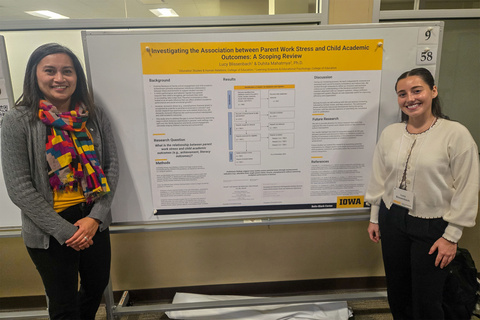
Through a lengthy process that involved identifying more than 600 articles, screening and narrowing the list using criteria they developed, conducting in-depth reviews of nearly 30 articles, and ultimately analyzing nine, Blissenbach and Mahatmya spent months carrying out their research. Through this process, Mahatmya watched Blissenbach grow.
“[Lucy] was never afraid to ask questions, and over time I saw a shift from being more of a student of research (taking it all in) to becoming the lead author on her HOP thesis and presentation,” recalls Mahatmya. “She created insightful themes from her data analysis that we will continue to expand upon for a publication.”
Blissenbach says one of the study’s most significant findings so far is just how understudied the topic remains.
“We know parents are stressed,” she says. “But there’s not a lot of research specifically looking at how stress from the workplace carries into the home and impacts children academically.”
Many studies suggested that there is a correlation between parents’ work stress and negative impacts on their children’s learning, and that the effects are often indirect.
“It shapes children indirectly—parents feel overwhelmed by their workday and then can’t help their kids with homework that night. Simple things like that—but then their child doesn’t do their homework,” she says.
“It’s so important because it’s very under-researched, and it’s not something that people think about,” Blissenbach says.
In April, Blissenbach presented her research at the Belin-Blank Center in what she describes as a nerve-wracking but rewarding experience.
“Everyone there was coming to listen and learn and support me on what I’d done, so I felt some sense of calm in that,” she recalls. “My friends and roommates came and supported me as well, which was so nice.”
Blissenbach and Mahatmya hope to continue refining the project and submit it for publication in the year ahead.
After graduation, Blissenbach plans to return to Minnesota while exploring career options with her focus on education and working with children. She’s especially interested in working with children with special needs in school or day center settings.