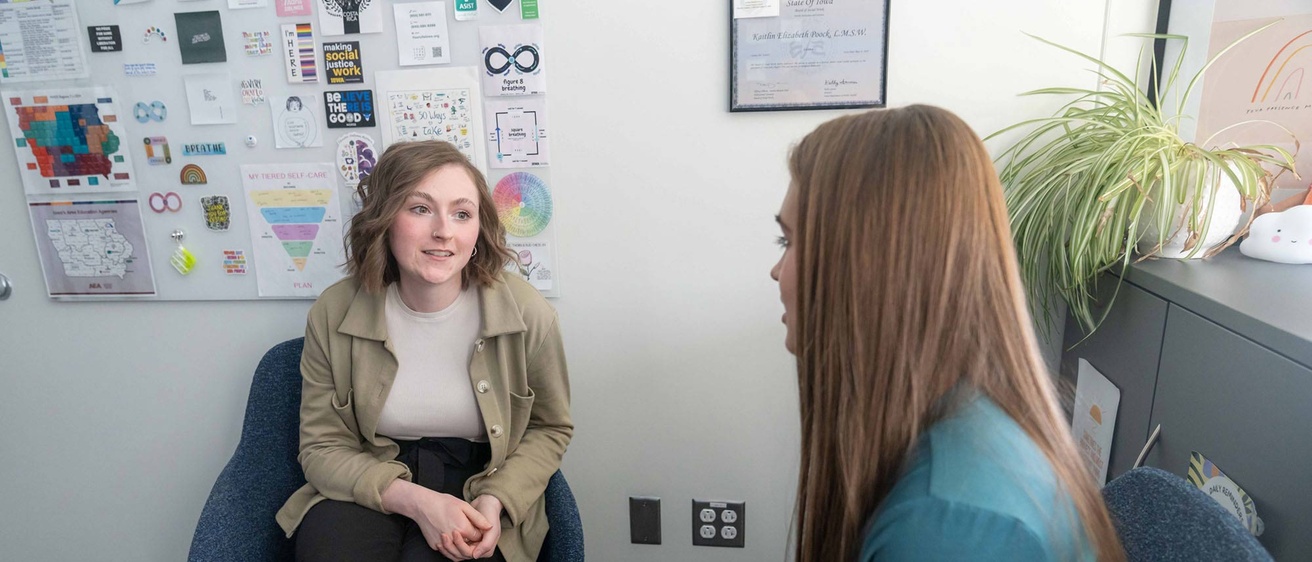
Kaitlin Poock, LMSW, found her calling in school mental health through a transformative practicum experience at the University of Iowa’s Scanlan Center for School Mental Health (SCSMH).
Raised by two educators, Poock spent much of her childhood in school buildings. Though she didn’t envision herself as a classroom teacher, the school environment felt like home. While studying psychology at Luther College, an elective in social work changed her trajectory.
“That class opened my eyes to the person-in-environment theory,” Poock says. “Social work’s commitment to service and human connection matched my personal values.”
During her Master of Social Work program at Iowa, Poock was introduced to the SCSMH clinic. Then in its early stages, the clinic offered a unique chance to help build something from the ground up. She jumped at the opportunity.
As a practicum student, Poock supported initiatives like CARES, a pilot study assisting high schoolers after psychiatric hospitalization. She shadowed full-time clinicians, worked directly with K–12 students and school staff, and even coined the term “Donuts and Debriefing” for a key post-crisis relationship-building activity.
SCSMH, launched in 2021, focuses not only on serving schools but also on training future mental health professionals.
“It’s not enough to simply provide mental health services – we must also help grow the next generation of providers,” says Alissa Doobay, director of clinical services.
Since its founding, the center has trained 21 graduate-level students.
When a full-time position opened at the clinic, Poock eagerly applied. “I felt aligned with the clinic’s mission to expand access to mental health care for K–12 students and staff,” she says.
Now nearly two years into her role, Poock provides individual and group counseling, suicide prevention training, and post-crisis support, while working toward her independent licensure. She’s contributed to clinic resources and authored two of its most-read blogs on mindfulness and classroom transitions.
Poock integrates approaches like Cognitive Behavioral Therapy, Dialectical Behavior Therapy, and mindfulness, always tailoring therapy to her clients’ needs. Self-care remains a priority – she practices daily mental resets and is currently training for a half-marathon.
Looking ahead, Poock hopes to incorporate dance and movement therapy into her work. “I want to be the type of clinician who is continuously learning,” she says, “and I’m proud to be part of a team working to make mental health care accessible across Iowa.”
Read more from the 2024-2025 Annual Report.