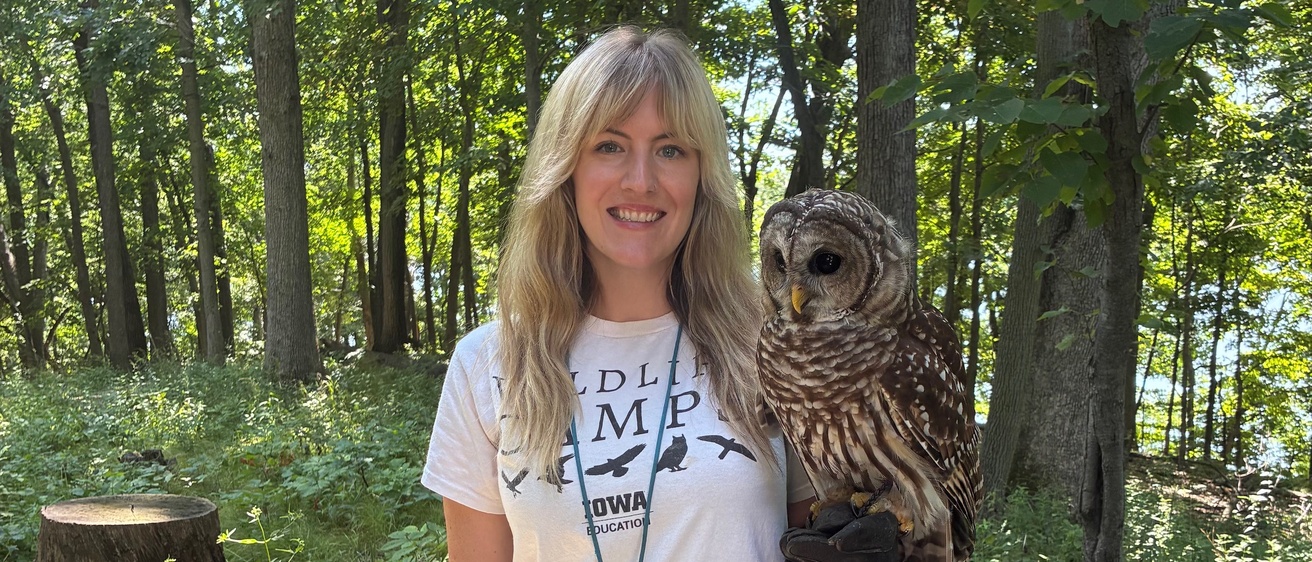
With 13 raptors in her care and dozens of educational events under her belt, Katie Ibsen’s first year with the Iowa Raptor Project has truly taken flight.
The Iowa Raptor Project, one of three programs under UI WILD (Wildlife Instruction and Leadership Development), works to conserve Iowa’s birds of prey through education and research. In June, Ibsen became the program’s assistant director after spending a year as its raptor education and care coordinator.
Since May, Ibsen has delivered more than 80 educational programs. These programs, which include traveling events and tours, combine live raptor demonstrations with interactive learning activities.
Ibsen says that the IRP’s aim is to create bonds between people and the birds. With conservation as the ultimate mission, she believes it’s critical for people to understand what's at stake. Threats like habitat loss and pesticide use contribute to a declining raptor population both nationally and in Iowa.
“The goal is to give people a close interaction with our birds, because close interactions create this important and unbreakable bond between humans and birds,” Ibsen says. “It’s essential because people only protect what they love.”
Ibsen’s own love for wildlife is older than she can recall, but it was molded into a passion after attending UI WILD’s School of the Wild and Wildlife Camps as a child. By the time she began her studies at Kirkwood Community College, she had declared a major in Parks and Natural Resources Associate of Applied Science.
After graduating from Kirkwood, Ibsen pursued a Bachelor of Science in Wildlife Education at the University of Wisconsin-Stevens Point. There, she completed a 16-week environmental education practicum and a six-week field experience in natural resources.
While at Kirkwood, Ibsen sought out opportunities related to conservation and affirmed her love for raptors during an internship with the World Bird Sanctuary in St. Louis, Missouri. She also worked with Iowa County Conservation and the Raptor Education Group in Antigo, Wisconsin before starting her own nonprofit, Avian Connections, in 2021.
Avian Connections was Ibsen’s passion project. She obtained education permits for her three birds – Shiloh the turkey vulture, Vlad the black vulture, and Juniper the northern saw-whet Owl – and delivered educational programs in Prairie Du Chen, Wisconsin for three years.
In 2024, after a decade in Wisconsin, Ibsen decided to return to Iowa City. She joined the Iowa Raptor Project in August as its raptor education and care coordinator, bringing her birds with her.
In her original position and now as assistant director, Ibsen provides husbandry (or caretaking) to the 13 non-releasable raptors in the IRP’s care. She and her team spend hours each day with the birds, including training for programs.
The IRP’s raptors are often called “ambassadors” because of their role in educating the public. Ibsen and her ambassadors perform at events across Iowa to raise awareness for the organization and the dangers facing raptors.
These demonstrations are essential to Ibsen’s outreach strategy, and she has plans to make them even more engaging.
“Throughout my time as an educator, I’ve often realized that just standing with a bird on the glove while strictly discussing their natural history can get a bit dreary,” Ibsen says. “I like to bring a variety of props, demonstrations, and touchables, just to try to find unique ways to put on more of a bird show, which is what I had a lot of experience doing in my former work. It's something I'm really excited to do.”
Ibsen is already working with her birds on flight training for the fall in the hopes of an even more engaging part of the programming. The ultimate goal is to have the raptors fly over the audience in some programs.
Developing the programs to be The more captivating the demonstration, the greater the opportunity to inspire the audience.
“At the end of each bird before we put them away, we discuss their stories, why they couldn't be released into the wild, and how people can make an impact. I like to teach what individuals can do to help – talking about those little things that people can do in their own world and own life that make a difference for the raptors.”
Ibsen emphasizes both industrial problems facing the raptor population – habitat loss, pesticide use – and those that individual people can prevent.
For example, Ibsen encourages pet owners to keep cats indoors. With age-appropriate groups, Ibsen shares a tale from her time in a raptor rehabilitation facility when a nest full of fledgling kestrels was lost to a roaming cat. The hope, as with all programming, is to make an impact on individuals and inspire them to protect Iowa wildlife.
With a deep passion for conservation and a vision for more engaging and impactful programming, Ibsen is excited to help the Iowa Raptor Project soar into its next chapter – one connection at a time.