
It’s no secret that effective and well-rounded teachers have a strong educational foundation that’s rooted in high-caliber instruction from a top-notch collegiate education program.
But what about aspects of the profession that can’t be taught? What about real-world scenarios that can’t be duplicated in a college classroom and need to be experienced firsthand?
Future educators rely on current teachers to donate their time and experience through various mentoring opportunities. At the University of Iowa, established teachers showcase the nuances of classroom instruction and create a platform for future educators to develop and refine their individual teaching styles through the College of Education’s Cooperating Teachers (CT) program.
Whether hosting student teachers or practicum students, cooperating teachers are needed to provide field experience students a valuable mentorship opportunity before entering the profession. In this role as a trusted mentor, CTs help facilitate an immersive experience that gradually supports and prepares the students for their professional endeavors.
Once placed in a cooperating teacher’s classroom, field experience students begin to hone professional dispositions that will guide future decision-making. They also gain valuable experience in curriculum and instructional strategies, classroom management, lesson planning, professional learning communities, and establishing a positive classroom environment.
Ben Smith, a kindergarten teacher at Horace Mann Elementary in the Iowa City Community School District, has experienced the inherent value of the CT program, both as student and as a current cooperating teacher.
As an elementary education student going through the program, Smith’s placement with a CT allowed him to see and experience a different side of teaching.
"Everyone has their own strategies and styles of instruction. Sometimes those styles matched the strategies I was focused on and sometimes they didn’t. Regardless, I found the opportunity to reflect on new ways to teach very interesting and meaningful,” says Smith.
When reflecting on his participation as a student, Smith, who graduated from UI’s Elementary Education program with endorsements in science, math, and reading, recognizes the lasting impact of the mentorship he received, and to this day feels very fortunate about his placement.
“I happened to hit the lottery and was placed with an amazing, student-focused, and brilliant teacher, Stacey Medd,” says Smith. “Stacey and her students pushed me to try something, reflect, and to try again. This taught me pedagogical tools that I’m still refining today.
“In addition, I had the opportunity to think deeply about my philosophical priorities in the classroom. I think this is something that we’re all always going to be working through but I’m grateful that I was given strong early encouragement to see the litany of amazing things that all students bring to our classrooms every day.”
Paying it Forward
As someone who directly benefited from the CT program when he was a student, Smith was more than happy to volunteer to mentor the next generation of educators by becoming a cooperating teacher himself.
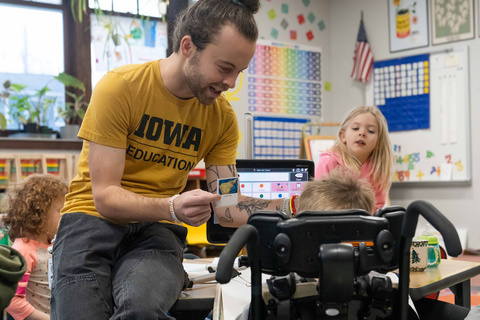
With five years of teaching experience (a minimum three years is required), a passion for the education profession, and the desire to mentor, he was a natural fit.
“I want to be able to offer as much as I can to the students teaching in our classroom. Knowing that I’m still early in my career, I think it’s been valuable to invite the students to play around in planning with me. I can’t guarantee that anything I’m showing is the right way to do something but I’d love to give the same chances to reflect on teaching that I was given. Opportunities to try, learn, and try again.
“Participating as a CT and welcoming reading practicum teachers into our classroom is also a benefit to my students. They get the opportunity to learn from different types of teachers with different, creative ideas,” says Smith.
While Clear Creek Amana (CCA) middle school principal Brad Fox did not personally participate in the CT program, he consistently emphasizes the importance of cooperating teachers and has been adamantly encouraging his teachers to participate for several years. He believes it’s important for established teachers to offer mentorship as a CT, providing a hands-on, unique perspective for future educators.
“Just having that relationship with a cooperating teacher and being able to learn from them while you’re in college … it’s truly invaluable,” says Fox. “When I student taught, the cooperating teacher I was assigned to told me the first day that he had a student teacher every semester for about 20 years. I worked really hard to gain his trust and he inevitably opened up to me about the profession. His mentoring was definitely a key point in my career.”
A Two-Way Street
Fox also recognizes that participating in CT programs benefits the school by introducing administrators to aspiring educators who could potentially help address teacher shortages and fill a critical void.
“I look at the value added. I don't know why schools would not want to be a part of what is really a first look at new teachers,” says Fox. “One thing that’s changed pretty drastically in my career is that the pool of teachers has definitely become smaller. Not as many people are going into education so I really want to have a jumpstart on that pool and look at student teachers because in my head I'm always thinking where they might fit in on our staff. And when you get to add another person to your school that has a passion for teaching and working with kids, that’s a win-win in my opinion.”
For those teachers who might be on the fence about volunteering, Fox offers a sensible perspective.
“I would say give it a try … see what value it adds. If you've never experienced it, give it a shot. I think the gains and the benefits of participating make it a very worthwhile endeavor,” says Fox. “Our CTs help student teachers learn from experience and hopefully they’ll do a better job when they have that first interview and have a decent idea of what happens when an administrator comes in and observes them teaching.”
Smith’s advice to current educators who are unsure about the time commitment and participating as a cooperating teacher is worth noting.
“I would say that the payoff is huge. With the relationships my students build, the bonds I establish, and the energetic thinking that’s added to the classroom … all these things vastly outweigh the additional time that it may take to host a practicum student. For me, the CT program has always been a meaningful and rewarding experience.”