
The University of Iowa is proud to host the 27th Midwest Association of Language Testers Conference (MwALT) in October 2026. Join us as we welcome MwALT back to Iowa City for the fifth time.
MwALT 2026 invites submissions that examine language assessment from diverse perspectives. The theme, Language Assessment Through Multiple Lenses: Uses, Innovations, and Impacts, highlights three interrelated dimensions of the field:
- Uses: the practical applications of language assessments in educational, professional, and social contexts.
- Innovations: emerging methodologies, technologies, and tools shaping language assessments.
- Impacts: the broader effects of language assessments on learners, educators, institutions, and society.
Submissions may address theoretical or empirical questions related to, but not limited to, stakeholder roles, ethical considerations, assessment literacy, sociopolitical contexts, and technological innovations (e.g., Generative AI, NLP). Proposals across all educational levels and contexts, including K-12, higher education, professional settings, government, and the private sector, are encouraged. We particularly welcome submissions that foster critical reflection and dialogue on best practices, ethical and social implications, and future directions in language assessment.
Important Dates
Proposal submission opens: May 1, 2026
Submission portal closes: June 30, 2026
Results announced: July 31, 2026
Registration opens: August 15, 2026
Registration closes: September 30, 2026
Conference: October 10, 2026
Call for Proposals open from May 1 - June 30, 2026
Call for Proposals - Submission Instructions
The 2026 MwALT Conference invites submissions that examine language assessment from diverse perspectives. The theme, Language Assessment Through Multiple Lenses: Uses, Innovations, and Impacts, highlights three interrelated dimensions of the field:
- Uses: the practical applications of language assessments in educational, professional, and social contexts.
- Innovations: emerging methodologies, technologies, and tools shaping language assessment.
- Impacts: the broader effects of assessment on learners, educators, institutions, and society.
The conference provides a platform for researchers, practitioners, and policymakers to share insights, challenge assumptions, and explore assessment approaches that are both effective and equitable.
Submissions may address theoretical or empirical questions related to, but not limited to, stakeholder roles, ethical considerations, assessment literacy, sociopolitical contexts, and technological innovations (e.g., Generative AI, NLP). Proposals across all educational levels and contexts, including K–12, higher education, professional settings, government, and the private sector, are encouraged. We particularly welcome submissions that foster critical reflection and dialogue on best practices, ethical and social implications, and future directions in language assessment.
Submission Instructions
All submissions must be original and not previously presented elsewhere. Abstracts should not exceed 300 words. During submission, authors may indicate their preferred presentation format: Paper Presentation or Roundtable Discussion.
- Paper Presentation: Papers should present theoretical or empirical research and are allocated 20 minutes for presentation plus 10 minutes for Q&A. Empirical papers should include research background and rationale, methodology, findings, and implications. Conceptual papers should describe the problem addressed, the theoretical orientation or new approach, and the logic of the argument to be presented.
- Roundtable Discussion (including Work-In-Progress): This format provides an opportunity for presenters to discuss assessment research or test development projects with a small group of participants. Each presenter will have three 20-minute discussion segments to display their work and engage participants in discussion and feedback. Presentations should focus on methodology, preliminary results, and next steps, inviting participants to offer suggestions and perspectives. Research-in-Progress submissions are welcome.
Submissions open from May 1 to June 30, 2026.
Submit your proposal.
Evaluation of Proposals
All submissions will undergo double-blind review by at least two reviewers. Proposals will be evaluated based on the following criteria:
- Clarity and coherence of the proposal
- Appropriateness of methods for data collection and analysis (if applicable)
- Alignment with the conference theme
- Significance and implications for the field of language assessment
Preference will be given to proposals addressing the conference theme, though all topics in language assessment are welcome.
Proposal review results will be announced around July 31, 2026.
Registration
Conference registration is open August 15 - September 30, 2026.
Please contact us at MwALT-2026@uiowa.edu if you do not receive a confirmation email after registering.
Conference Registration Rates
Registration for MwALT 2026 includes admission to all conference sessions, refreshments, and lunch on October 10.
Early Registration (Before September 9) | Regular and On-Site Registration (September 10–30; October 9–10) | |
| Student | $30 | $40 |
| Faculty, Practitioners, Researchers | $120 | $140 |
Refund and Cancellation
To cancel your registration, please contact us at MwALT-2026@uiowa.edu to request a refund. Refund requests will be accepted and processed through the end of the conference.
If you would like to cancel your presentation, please notify us immediately.
Accommodations
We are pleased to announce that two hotels in downtown Iowa City are offering special rates for the MwALT 2026 conference!
- Please note that the special rate is available for check-in on October 9 or October 10. Guests may stay both nights consecutively at the same rate.
- Reservations must be made by September 9 (the cut-off date) to secure the special rate.
If you are unable to book a room at the hotel using the special MwALT rate, don't hesitate to contact the conference organizing committee first at MwALT-2026@uiowa.edu. We may be able to check availability with the hotel manager.
Hilton Garden Inn
Reserve your room at the Hilton Garden Inn.
Address: 328 S Clinton St, Iowa City, IA 52240
Distance: 6-minute walk (2-minute drive)
Directions to the conference venue: View on Google Maps
Website: Hilton Garden Inn Iowa City Downtown University Hotel
Room types:
1 King Bed Room
2 Queen Beds Room
Room rates: $119.00 per night + taxes
Additional charge:
Parking: $15.00 per day
Hot breakfast: $13.95
Element Iowa City
Reserve your room at the Element Iowa City.
Address: 314 S Clinton St, Iowa City, IA 52240
Distance: 6-minute walk (2-minute drive)
Directions to the conference venue: View on Google Maps
Website: Element Iowa City | Pet-Friendly Long-Stay Hotel
Room types:
Guest room, 1 King
Studio, 2 Queen, Sofa bed
Room rates: $119.00 per night + taxes (rates include complimentary breakfast)
Parking: $15.00 per day at the Court Street Transportation public parking garage
Graduate by Hilton Iowa City (Overflow hotel, NO special rate)
Address: 210 South Dubuque St, Iowa City, IA 52240
Distance: 7-minute walk (2-minute drive)
Directions to the conference venue: View on Google Maps
Website: Graduate by Hilton Iowa City Hotel near University of Iowa
Local Information
Venue
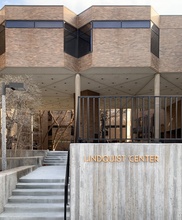
All the conference activities will be held at the Lindquist Center, home of the College of Education at the University of Iowa.
- Location: 240 S. Madison St., Iowa City, IA 52242.
- Directions to the Lindquist Center.
Parking
There are two parking facilities within walking distance of the Lindquist Center: the Library Lot and the Capitol Street Ramp.
- Library Lot
- Address: 123 Museum Dr., Iowa City, IA 52242
- Parking rate: $1.75 per hour (daily maximum: $30)
- Capitol Street Ramp
- Address: 220 S. Capitol St., Iowa City, IA 52242
- Parking rate: Free for the first hour; $2 for each additional hour (daily maximum: $16)
For other parking options on campus, consult the Parking Map and Public Parking Availability.
Restaurants
There are numerous restaurant options within walking distance of the Lindquist Center, offering a wide variety of cuisines and dining options. For a full list of restaurants in the Iowa City Downtown District, see the Dine & Drink webpage and the Official Dining Guide.
Wi-Fi
Free Wi-Fi service is available for conference participants. To connect, please select UI-Guest from the list of available wireless networks. After that, a browser page will be displayed on your device. Confirm the connection and agree to UI-Guest’s Terms of Service to enable the service. Please note, however, that the UI-Guest network is not encrypted.
Travel from Eastern Iowa Airport (CID)
The Eastern Iowa Airport (CID) is the closest airport to the University of Iowa and is located approximately 22 miles (35 km) north of the Lindquist Center. The drive to campus typically takes 25–35 minutes, depending on traffic. Conference participants may travel to the Lindquist Center by rideshare services (Uber or Lyft), airport shuttles, rental car, or public transportation. Check the airport Ground Transportation Services page for more information.
Conference Schedule
Room key: N = North Lindquist Center; S = South Lindquist Center; BTLC = Baker Teacher Leader Center, Floor 1, North LC.
| Time | Session | Location | Title | Presenter |
|---|---|---|---|---|
| 07:30–08:15 | Check-in & Light Breakfast | Jones Commons (N300) | — | — |
| 08:15–08:30 | Welcome and Opening Remarks | S301 | — | Lia Plakans & Mark Chapman |
| 08:30–09:15 | Opening Plenary | S301 | Technology as a Mediator of Language Assessment: From Construct Representation to Test-Taker Experience | Ping-Lin Chuang |
| 09:15–09:45 | Coffee Break 1 | Jones Commons (N300) | — | — |
| 09:45–10:15 | Concurrent Session 1 | S110 | Researcher Degrees of Freedom in Measurement of Verbatim Source Use | Rebecca Yeager & Xuan Hu |
| 09:45–10:15 | Concurrent Session 1 | S112 | Project-Based Authentic Assessment Through Korean Folktales | Weejeong Jeong |
| 09:45–10:15 | Concurrent Session 1 | S116 | Developing Meaningful Score Reports: Bringing Educators’ Lived Realities into Focus | Monique Yoder |
| 09:45–10:15 | Concurrent Session 1 | S118 | AI-Human Scoring Consistency Across Subgroups | Bui Nhat Anh Vu, Edward Wolfe & Yen Vo |
| 10:20–10:50 | Concurrent Session 2 | S110 | L2 Speech Fluency: Collocation Knowledge and AI in Fluency Assessment | Jinman Fu |
| 10:20–10:50 | Concurrent Session 2 | S112 | Test-Taker Presence, Workload, and Perceptions of an Embodied GenAI Partner | Sebnem Kurt |
| 10:20–10:50 | Concurrent Session 2 | S116 | Meaningful Measures: Effectiveness of Computer-Based Speaking Assessments for Real-World Communication | Ellen Barrow & Sarah Hughes |
| 10:20–10:50 | Concurrent Session 2 | S118 | (Best Student Paper) Development and Initial Validation of the International Teaching Assistant Speaking Anxiety Scale (ITA-SAS) for High-Stakes Oral English Certification Assessments | Young-Joo Lee |
| 10:55–11:25 | Concurrent Session 3 | S110 | Validating Feedback Use of a ChatGPT-Powered Dynamic Pragmatics Assessment System | Gi Jung Kim |
| 10:55–11:25 | Concurrent Session 3 | S112 | Assessing Teacher Language with AI Feedback | Kyongson Park |
| 10:55–11:25 | Concurrent Session 3 | S116 | Shaping Effects of Web Accessibility Guidelines on Online Assessment Innovation | Monique Yoder, Runlan Liu & Mark Chapman |
| 10:55–11:25 | Concurrent Session 3 | S118 | Effects of Test Announcement and Proficiency in Video-Based Listening Assessment | Elena Gorshkova |
| 11:30–12:00 | Concurrent Session 4 | S110 | Developing an Evaluation Survey for AI-Generated Items for Young ELs | Jeanne Beck, Sebnem Kurt, Young-Joo Lee, Sara Ahlers, Shaeley Santiago & Lorraine Sova |
| 11:30–12:00 | Concurrent Session 4 | S112 | Expanding the True/False Task Leveraging AI: Evidence from Spanish Learners | Kwangmin Lee |
| 11:30–12:00 | Concurrent Session 4 | S116 | Revising Writing Assessment in L2 Classrooms Through an AI-Informed Lens | Meredith Bricker |
| 11:30–12:00 | Concurrent Session 4 | S118 | AI Support and Score Dependability in Speaking Assessment | Dan Song |
| 12:00–13:00 | Lunch | Jones Commons (N300) | — | — |
| 12:00–13:00 | Business Meeting | Closed Meeting, S116 | — | — |
| 13:00–13:50 | Roundtable 1 | BTLC | Emotional Resonance as a Missing Lens for Multilingual Assessment Interpretation | Laura Clark Briggs |
| 13:00–13:50 | Roundtable 2 | BTLC | Assessing Participation in Meaning-Making Among Adult Multilingual Learners | Syed Usman Hashmi |
| 13:00–13:50 | Roundtable 3 | BTLC | Beyond Agreement: MFRM Analysis of Human and LLM Writing Scoring | Duong Nguyen, Mostafa Ranjbar & Men Truong |
| 13:00–13:50 | Roundtable 4 | BTLC | Toward an Alternative Oral Proficiency Assessment for China's English | Wei Wang |
| 13:00–13:50 | Roundtable 5 | BTLC | Verbalization Elicitation in Reports of L2 Writing Processes | Sarah Goodwin |
| 13:00–13:50 | Roundtable 6 | BTLC | Modeling Examiner Consistency in a High-Stakes West African English Examination | Babatope Stephen Falohun |
| 13:00–13:50 | Roundtable 7 | BTLC | AI Software for Oral Expression Assessment | Michael Mutti |
| 13:00–13:50 | Roundtable 8 | BTLC | Comparing Comprehension and Reporting in Integrated Reading-Writing Assessment | Rurik Tywoniw |
| 13:00–13:50 | Roundtable 9 | BTLC | Rethinking Writing Assessment in the Age of AI | Hamidreza Moeiniasl |
| 13:00–13:50 | Roundtable 10 | BTLC | Evaluating Prompt Design for Automatic Item Generation in Reading Assessment | Xuan Hu & Xinyi Ma |
| 13:55–14:25 | Concurrent Session 5 | S112 | A Case Study on Pre-Service Teachers’ Language Assessment Literacy | GoMee Park, Frank Giraldo & Alejandro Perez Belda |
| 13:55–14:25 | Concurrent Session 5 | S116 | Re-Envisioning Task-Based Language Assessment Through a Critical Multilingual Lens | Koen Van Gorp |
| 13:55–14:25 | Concurrent Session 5 | S118 | Qualitative Research in Language Testing (1984–2026): An Historical Perspective | Andy Jiahao Liu |
| 14:30–15:00 | Concurrent Session 6 | S110 | Can Measurement Factors Explain Previously Observed Cognition–Behavior Associations? | Young-Joo Lee |
| 14:30–15:00 | Concurrent Session 6 | S112 | DIF in Audiovisual Listening Tests for Young English Language Learners | Sun-Young Shin & Senyung Lee |
| 14:30–15:00 | Concurrent Session 6 | S116 | Development of a Novel Pragmatic Comprehension Task for Listening Assessment | Erika Latham |
| 14:30–15:00 | Concurrent Session 6 | S118 | Do L1 and L2 Response Options Matter in Language Assessment? | Junhee Park |
| 15:05–15:35 | Concurrent Session 7 | S110 | Rethinking Academic Writing Assessment Constructs Through Generative AI | Xinyue Shui |
| 15:05–15:35 | Concurrent Session 7 | S116 | Criterion-Related Validity Evidence for C-Tests: The Updated TOEFL iBT® Test | Renka Ohta & Xinyi Ma |
| 15:05–15:35 | Concurrent Session 7 | S118 | Aligning AAPPL Content and Scores to the CEFR Framework | Reuben Vyn, Camelot Marshall, Meg Malone, Abbie Finnegan & Carly Favero |
| 15:35–16:05 | Coffee Break 2 | Jones Commons (N300) | — | — |
| 16:05–16:50 | Closing Plenary | S301 | Humanizing Approaches for Language Assessment in the Age of GenAI: Peoples and Possibilities | Jamie L. Schissel |
| 16:55–17:20 | Closing and Award Ceremony | S301 | — | Lia Plakans |
Plenary Speakers

Jamie L. Schissel
Presentation - Humanizing Approaches for Language Assessment in the Age of GenAI: Peoples and Possibilities
Jamie L. Schissel is a Professor of TESOL and coordinator for M.Ed. TESOL and Add-on ESL/Dual Language Education certificate programs. Her research focuses on assessment, policy, and teacher education with(in) culturally and linguistically diverse communities. Through historical analyses and participatory action research collaborations, these projects emphasize relationship-building to improve educational opportunities. She is the editor of TESOL Quarterly Forum, and her work has been published in journals such as Applied Linguistics, Language Assessment Quarterly, Language Policy, Language Testing, Linguistics and Education, and TESOL Quarterly. In 2021, she received the AERA Bilingual Education Research SIG Early Career Scholar Award. She is co-founder and co-facilitator of two language assessment associations: Asociación Mexicana de Evaluación de Lenguas Indígenas [Mexican Association for the Evaluation of Indigenous Languages] and Association of Language Teachers for Classroom Assessment in the Dominican Republic. Across teaching, research, and service, she focuses on the care of those around her.
Presentation Abstract - Humanizing Approaches for Language Assessment in the Age of GenAI: Peoples and Possibilities
The field of language testing and assessment—like the overall field of educational measurement—has been an earlier adapter and innovator of technological advances. As detailed in the 2025 special issue of Language Testing, the prevalence of Generative Artificial Intelligence (GenAI) presents significant promises and challenges. Many of these challenges exacerbate existing issues faced by culturally and linguistically minoritized (CLM) test-takers. It is within this landscape that this talk situates humanizing approaches for language assessment. Humanizing assessment presents an overall perspective that the lived experiences of test-takers are inherently valuable for practices of assessment design, development, implementation, interpretation, and understanding consequences of use. Humanizing practices are well-established as pedagogical and research approaches. There has been a growing emphasis on adopting humanizing assessment practices across multiple disciplines as well. As a complex area of intersecting research, the transdisciplinary lens of language assessment has been opening pathways for state-of-the-art contributions for understanding humanizing assessment practices through theoretical, empirical, and practice-based research that focuses on the humanity and dignity (cf ILTA Code of Ethics 2000 Principle 1; 2024 Principle of Respect) of CLM test-takers in particular. Using testimonio-as-methodology, I present narratives from CLM test-takers in the United States and Mexico who are leaders in the field of language education. CLM in these contexts means self-identifying as immigrant, transnational, Indigenous, and/or other less clearly delineated categorizations. Their narratives contribute to a complex mosaic of understandings of the peoples who are needed to take assessments and the potentials for assessments moving forward. Their perspectives provide a vast array of often underrepresented perspectives and approaches that serve to advance the field of language testing and assessment overall. To conclude, I discuss how engaging and galvanizing research focused on humanizing approaches for language assessment can guide the important work with CLM test-takers forward.

Ping-Lin Chuang
Presentation - Technology as a Mediator of Language Assessment: From Construct Representation to Test-Taker Experience
Ping-Lin Chuang is a Language Measurement Scientist at Duolingo, where she conducts validity and efficacy research for the Duolingo English Test. She received her PhD in Linguistics from the University of Illinois at Urbana-Champaign. Her research focuses on writing and speaking assessment, including test-taker performance and rater behavior, as well as the application of technology and psycholinguistic methods in language assessment. Her work has been published in Language Testing, Journal of Second Language Writing, Studies in Second Language Acquisition, and Applied Linguistics. Ping-Lin previously served as an MwALT Student Representative and is currently Co-Chair of the ILTA Integrated Assessment Special Interest Group. She was a recipient of the MwALT Best Student Presentation Award (2021, 2024), the Robert Lado Memorial Award (2022), and the ILTA Student Travel Award (2022).
Presentation Abstract: Technology as a Mediator of Language Assessment: From Construct Representation to Test-Taker Experience
Recent advances in technology have profoundly reshaped language assessment, influencing not only how tests are delivered and scored, but also how language ability is conceptualized and interpreted. As assessment practices increasingly integrate automation, generative artificial intelligence, and digitally mediated environments, long-standing assumptions about constructs, evaluation, and test use warrant renewed examination (Voss et al., 2023; Xi, 2023). In this plenary, I will position technology as a mediator in language assessment and examine this role through three interconnected perspectives in a digital-first assessment context.
First, I will consider construct representation through vocabulary assessment by examining how psychometric difficulty relates to underlying linguistic features. Differences between expected and observed response patterns invite reflection on how language constructs are represented in technology-mediated assessments. Second, I will turn to scoring and evaluation, exploring how human judgments of writing and speaking performance play a crucial role in automated scoring systems. Technology allows human evaluation to be scaled, supporting scoring that is consistent and aligned with the intended construct, while also highlighting the need to examine potential bias. Third, I will address assessment use and impact by exploring how digitally mediated practice environments influence test-taker affect and performance, extending the consequences of assessment beyond the test itself.
Together, these perspectives demonstrate the need to view language assessment as an integrated system in which design, scoring, and use are deeply connected through technological mediation. I will conclude by discussing implications for validity, ethics, and innovation in language assessment, and by reflecting on how the field might respond to the opportunities and challenges posed by technological advancements.
Organizing Committee
- Lia Plakans, Professor of Multilingual Education, University of Iowa
- I-Chun Vera Hsiao, Postdoctoral Researcher, National Taiwan University of Science and Technology
- Xinyue Shui, PhD Candidate in Multilingual Education, University of Iowa
- Andy Jiahao Liu, PhD Student in Multilingual Education, University of Iowa
- Kwangmin Lee, Assistant Professor of TESOL, Western Michigan University
- Renka Ohta, Senior Research Project Manager, ETS
- Ray J. T. Liao, Associate Professor, National Taiwan Ocean University
MwALT 2026 Sponsors
- Duolingo
- TOEFL
- WIDA
- Pearson
- Language Learning and Testing Foundation
- Department of Teaching and Learning, University of Iowa